Next

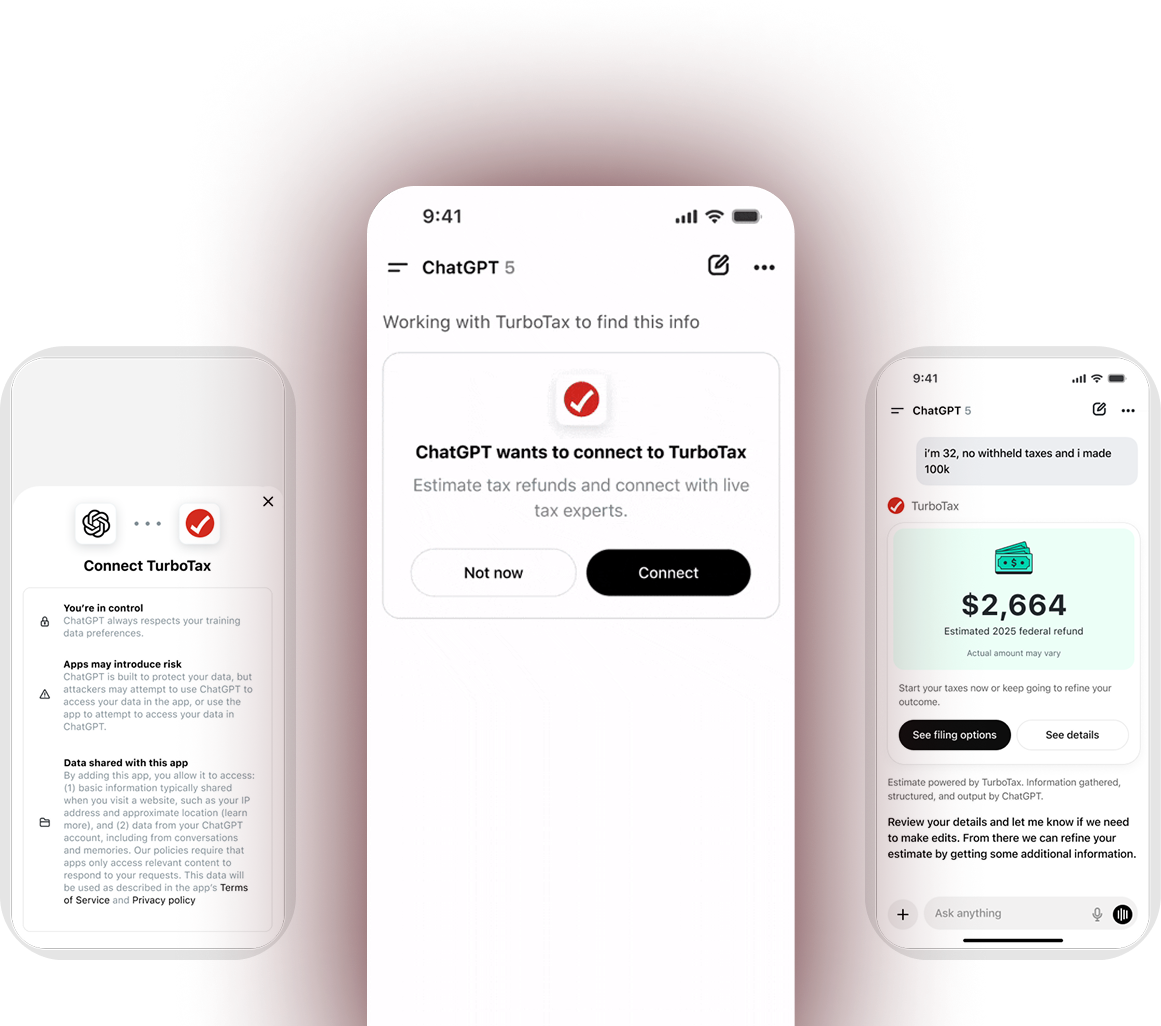
Agentic UX · Privacy & User Control
Designing a simple tax filing experience in ChatGPT
An exploration of tax guidance in ChatGPT that moves from questions and verified documents toward a draft filing in TurboTax, with attention to privacy and the handoff between products.
Role
Product design lead
Scope
0→1 design provocation
Define the initial product wedge and UX foundation for TurboTax's presence in ChatGPT.
Team

Product manager
Coordinated cross-functional delivery and decision-making.


User researchers
Ran quantitative evaluations of system-prompt conversation variants, informing the response patterns adopted in the MVP.


Software engineers
Guided markdown language standards and defined the technical architecture and data-storage / retention constraints.

Tax expert
Provided subject matter expertise on tax filing workflows.

Legal counsel
Defined compliance boundaries for PII and tax-data handling in chat.
My contribution

Product designer
I partnered across disciplines to translate strict legal, privacy, and technical constraints into a coherent user experience by cross-functional feasibility alignment across legal, privacy, and engineering to design an end-to-end conversational workflow within defined system behaviors.
Status
0→1 exploration that validated product direction
The problem
The opportunity
Initial hypothesis
Discovery
The design challenge
The design pivot
Delivered UX
Outcome
Back to top
The problem
People increasingly begin tax preparation by asking questions in conversational AI, but a tax question is not yet a secure, filing-ready workflow.
The experience needed to establish eligibility, consent, identity, document accuracy, and a clear transition into TurboTax—without treating chat as the system of record for filing.
The opportunity
A new front door for tax prep
Customers are already asking tax questions in conversational AI. The strategic opportunity was to turn that early intent into meaningful progress toward filing with TurboTax.
Initial hypothesis
Can we design an experience where simple filers can file their taxes directly in ChatGPT?
We selected simple filers as the initial MVP hypothesis as their returns required the least amount of documentation, making them the most feasible audience to build our hypothesis around.
Qualify
Confirm simple filer status
Gather
Collect W-2 and personal info
Prepare
Generate Form 1040
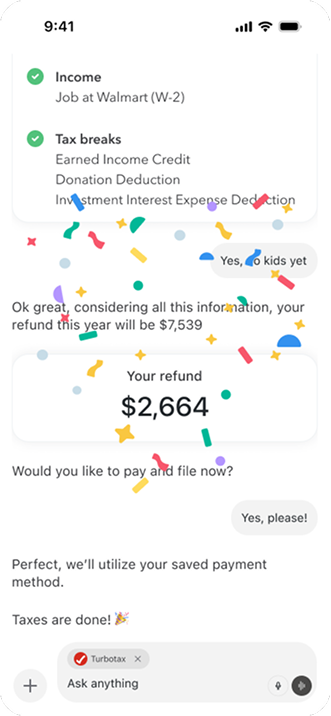
File in chat
Complete and submit the return
Discovery
Privacy, legal, compliance, and data-storage constraints limited what could be collected and retained.
Through cross-functional feasibility work with legal, privacy, tax, and engineering partners, we identified constraints on what could be collected and retained in conversation.
ChatGPT could start tax prep, but TurboTax needed to remain the system of record for review, disclosures, signature, and filing.
The design challenge
How might we...
Turn a tax question into a confident, filing-ready next step without moving the actual filing outside TurboTax?
The design pivot
Before
Prepare and file taxes directly in ChatGPT
Qualify
Confirm simple filer status
Gather
Collect W-2 and personal info
Prepare
Generate Form 1040
File in chat
Complete and submit the return
After
Start tax prep in ChatGPT
Qualify
Confirm simple filer status
Gather
Collect W-2 and personal info
Prepare
Generate Form 1040
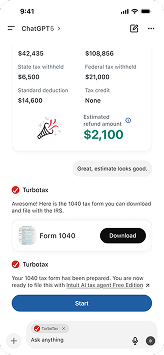
Continue in TurboTax
Review and file securely
Delivered UX
Guiding users through tax conversation, directly to tax prep.
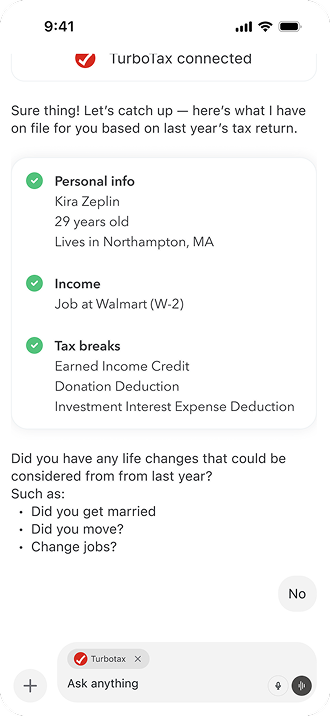
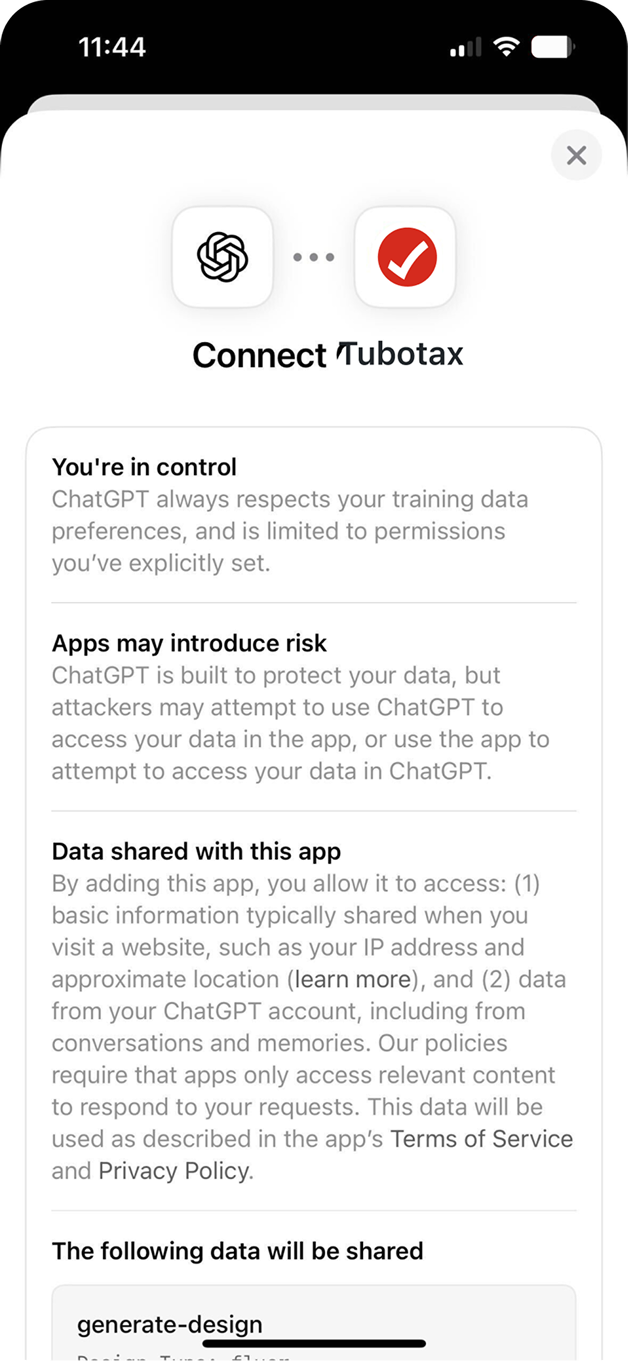
- 1.Connect & authorize: User connects TurboTax in ChatGPT and authorizes data sharing.
- 2.Signal intent: User explains what tax help they need.
- 3.Assess eligibility: System determines the appropriate filing path and routes unsupported cases as needed.
- 4.Verify identity: User verifies identity and reviews their personal profile.
- 5.Complete profile: System retrieves available information and requests missing or updated details.
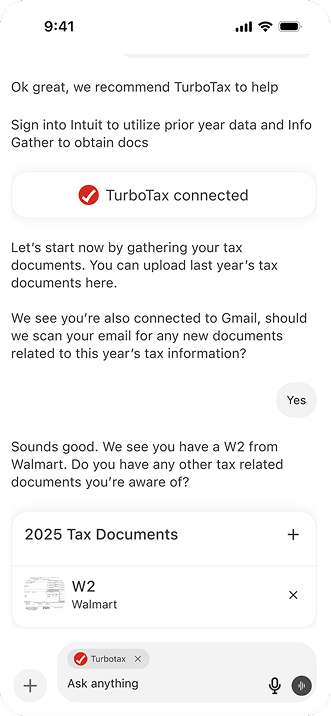
- 6.Create filing profile: System establishes filing status, dependents, income type, and required documentation.
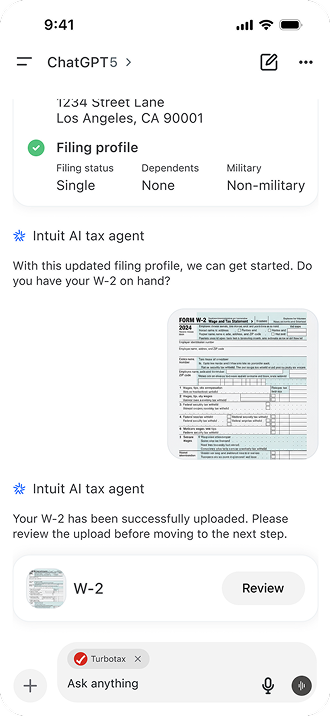
- 7.Upload documents: User uploads tax documents.
- 8.Extract data: System uses OCR to extract structured tax data.
- 9.Confirm extraction: User reviews and confirms extracted fields.
- 10.Resolve gaps: System flags missing, incomplete, or inconsistent information.
- 11.Collect remaining details: System asks targeted questions about income, deductions, and credits.
- 12.Generate return summary: System presents a draft tax-return summary.
- 13.Review draft: User confirms the summary and return preview.
- 14.Continue in TurboTax: TurboTax completes review, disclosures, signature, and filing.
Outcome
Viable product direction
Defined a compliant, customer-facing role for TurboTax in ChatGPT: start tax prep in conversation, then review and file in TurboTax.
Defined agentic actions
Specified what the agent could do, what it could collect, how it communicated workflow state, and when it needed to transition users out of chat.
A foundation for launch
Created the workflow and system-prompt requirements the team could carry into development and evaluate in a future tax season.